
The life insurer tinkered with its business strategy - raised the share of protection plans and reduced dependency on ULIPs in the past four years.

The early bird results for the January-March 2022 quarter (Q4FY22) hint at a slowdown in corporate sector growth in the upcoming quarters. The combined net sales of the 81 early bird companies in the Business Standard sample were up 15.1 per cent year-on-year in Q4FY22; this was less than the 15.9 per cent YoY jump reported in Q3FY22. The slowdown could be much stronger for the domestic market-focused companies, including those in the banking, finance, and insurance (BFSI) space.

Currently, TCS is India's second most valuable firm after Reliance Industries, which has a market cap of nearly Rs 12.9 trillion.
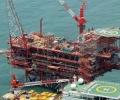
The government will decide in August whether to sell a 5 percent stake in ONGC, a senior oil ministry official said, in a deal that would be worth $2.9 billion at current market prices.

'Thankfully, most investors in India have now seen through this false narrative and are once again deploying their hard-earned money.

This is despite the private sector companies outperforming their public sector counterparts, reports Sachin P Mampatta.

These five stocks, which have lagged the markets over the last two years, have doubled in value since March 23.

While Mukesh Ambani-led RIL posted a 108 per cent YoY rise in profit after tax for Q4FY21 at Rs 13,227 crore, it fell short of Bloomberg estimate of Rs 13,704 crore.

'A soft landing of the Indian economy would be a long-term positive for the equity markets.'

Stocks offering attractive dividends contain downside better when the markets correct, advises Sarbajeet K Sen.

Equity benchmark Sensex tanked over 1,000 points in the opening session on Friday tracking losses in index majors ICICI Bank, HDFC twins and Reliance Industries amid a negative trend in global markets.

India has the lowest labour force participation rate in South Asia and one of the lowest in the world, points out Aakar Patel.
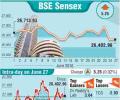

Investor wealth eroded by Rs 6.59 lakh crore on Monday as equities tanked after the UK reported a new strain of the COVID-19 virus. The 30-share BSE Sensex plunged 1,406.73 points or 3 per cent to close at 45,553.96. The benchmark hit an all-time high of 47,055.69 during the session. Following the sharp selling, the market capitalisation of BSE-listed firms plummeted by Rs 659,313.65 crore to Rs 1,78,79,323.05 crore.

The S&P BSE Sensex ended down 157 points at 28,052 and the Nifty50 slipped 28 points to settle at 8,639.

The ongoing consolidation in equities would improve return prospects during the second half of 2021, an American brokerage said on Tuesday. Leading indicators relating to fundamentals including growth, stability, government policy and RBI policy, and corporate earnings are "generally positive" about equity returns, analysts at Morgan Stanley said. It can be noted that since the start of the second wave of COVID-19 infections, which also coincided with inflation worries in the US, there has been an uneasiness within investors. From its levels on March 10, the markets are down by nearly 3 per cent despite the late surge over the last two trading sessions.

Check out some of the stocks that will react on the basis of their numbers in the near term.
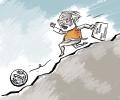
The Business Confidence Index (BCI) prepared by the Delhi-based think tank NCAER declined by 27.5 per cent in the first quarter of the current financial year over the previous quarter mainly on account of the second wave of the COVID-19 pandemic. The BCI on a quarter-on-quarter basis decreased by 35.3 per cent for the services sector, 32.9 per cent for the consumer durables sector, 32.3 per cent for the capital goods sector, 17 per cent for the intermediate goods sector and 14.3 per cent for the consumer non-durables sector, NCAER said in a release.

Tata Motors was the biggest gainer in the Sensex pack, rallying 2.94 per cent. It was followed by Vedanta, Bajaj Finance, Sun Pharma, ONGC, ICICI Bank, Bajaj Auto, Tata Steel, RIL, HDFC duo, L&T and SBI, rising up to 2.78 per cent.

Tata group companies have outperformed the broader market over the past four years, under the chairmanship of N Chandrasekaran. However, the group's fortunes rely heavily on the performance of Tata Consultancy Services (TCS) now, as compared to the past. The combined market capitalisation of the group's listed companies has nearly doubled in the last four years, against a 77 per cent rally in the benchmark Sensex during the period. The overall market value of 16 key group firms - excluding listed subsidiaries of such entities - stood at Rs 16.8 trillion as of Friday. This was close to 2x the Rs 8.45 trillion as of February 21, 2017 - the day Chandrasekaran took charge as chairman of Tata Sons.

SBI was the top gainer in the Sensex pack, jumping around 3 per cent, followed by Kotak Bank, Axis Bank, Bajaj Auto, Tech Mahindra, UltraTech Cement and PowerGrid. NSE Nifty rose 36.40 points to 15,337.85.

Companies that do not know why they are doing good also do not know why they are failing when they are on a downward slide, notes Baqar Iftikhar Naqvi, founder and CEO, Upriver, a sales accelerator firm.
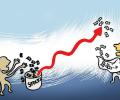
Small stocks made a dashing comeback in 2020 after delivering negative returns in the last two years as increased retail investor participation in pandemic times saw small-cap index surging up to 31 per cent and outperforming the bigger benchmark gauge. This year turned out to be eventful for the equity market, witnessing bearish and bullish sentiments at different points of time. While the initial part of COVID-ravaged 2020 saw the bears in full force amid concerns related to the pandemic and lockdowns hurting economic activities, bulls made a comeback towards the latter half of the year. As the market swayed with many lows as well as highs, small and mid-cap indices emerged as markets favourites in 2020.

The slowdown had been brewing since 2016 but was intensified further by several disruptions in the past two years including demonetisation.

Broader markets outperformed with BSE Midcap and BSE Smallcap adding 0.23% and 0.45%, respectively

The mid- and small-cap indices had a dream run between January 2017 and January 2018 - zooming 48 per cent and 56 per cent, respectively.

'The consolidation of the world's fifth-largest economy in the hands of 15-20 corporate giants is a once-in-generation event, which we are focusing on.'

Shares of small-cap companies have been on a roll with the S&P BSE Small-Cap index hitting a new high in intra-day deals on Thursday. The rally has been fueled by an up move in stocks of chemicals, cement, graphite electrode makers, pharmaceuticals and information technology (IT) shares. In the past two weeks, since March 25, the index has outperformed the market by gaining 7.3 per cent. In comparison, the S&P BSE Midcap index was up 6.1 per cent, while the S&P BSE Sensex gained 3.6 per cent during the same period.

The combined market capitalisation of the top 873 family-owned companies was down 26.3 per cent year-on-year (YoY) to Rs 61.8 trillion at the end of trading on Tuesday. It had grown 6 per cent in FY19 and nearly 20 per cent in FY18.

Waves of foreign portfolio investments worth over Rs 51,000 crore splashed into the Indian market in 2021 as overseas investors turned net buyers of domestic securities for the third straight year while excess global liquidity and other factors steered the ebb and flow of their investing ways. With the global financial system still flush with liquidity, emerging market assets, especially equities, might well remain the preferred investment avenue for many more months to come, experts opined. As the equities sizzled during most of 2021, that also saw economy slowly coming back into the recovery path, Foreign Portfolio Investors (FPIs) turned net buyers but their investment is much less compared to net inflows of Rs 1.03 lakh crore in 2020.

In the Sensex pack, IndusInd Bank was the top gainer, soaring around 8 per cent, followed by Bajaj Finance, Axis Bank, PowerGrid, ONGC, ICICI Bank, Sun Pharma and M&M.

Are we seeing a replay of March 2000? What are the similarities and differences and how worried should we be, asks Akash Prakash.

The S&P BSE Sensex ended down 156 points at 25,597.

Check out some of the stocks that will react on the basis of their numbers in the near term.

The 30-share Sensex ended up 11 points at 25,561 and the 50-share Nifty gained 16 points to end at 7,640 levels.
In the international study, 36 companies with CEOs promoted within the company outperformed others across seven measurable metrics: return on assets, equity and investment, revenue and earnings growth, earnings per share growth and stock-price appreciation, according to management consultancy AT Kearney.

On the BSE, 1,650 shares declined and 1,188 shares rose

The FPI holding in India's top 100 companies, which are part of the Nifty 100 index, declined to 24.23 per cent on average at the end of March this year, from a high of 27.5 per cent at the end of March 2021. This is the lowest FPI holdings in India's top listed companies in at least three years. A general sell-off by FPIs has weighed on stock prices and the benchmark S&P BSE Sensex is down 8.5 per cent, from its 52-week high made in October 2021. Most analysts expect FPI flows to remain weak in FY23 as well, given rising bond yields in the US and an expected earnings slowdown in India due to high inflation and commodity prices.
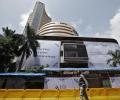
BSE Midcap and BSE Smallcap indices hit their fresh lifetime highs for the second day in a row
The liquidity-fuelled rally will continue for some time, however, fundamentals are getting stretched.
 © 2026 Rediff.com - Investor Information - Advertise with us - Disclaimer - Privacy Policy - Sitemap - Feedback - About us - Terms of use - Grievances